Italian road signs for the patente B: meaning and quiz

A sign is recognised by its shape first: a triangle pointing up warns of a hazard, a red bordered circle forbids, a blue circle orders, and the downward triangle and the stop octagon settle priority. Shapes and colours are fixed by the regulation implementing the Codice della Strada (d.P.R. 495/1992). Here are 45 signs with their meaning.
Try the full quiz Practise the warning signs
Name the sign
In the exam the sign is drawn rather than named, and it is recognised from its shape, colour and symbol. This drills that part, with no score and no clock.
The recognition drill needs JavaScript. Every sign and its meaning is listed below in any case.
Warning signs
A red bordered triangle, point upwards. They announce a hazard and require the driver to slow down, not to stop.
-
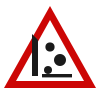
Falling rocks
Warns that rocks may fall from the slope and may already be lying on the carriageway.
-
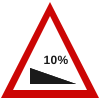
Steep descent
Announces a steep descent, with the gradient as a percentage. Reduce speed and use a low gear.
-
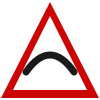
Hump
A change in the road profile that hides what lies beyond it. Slow down and do not overtake.
-
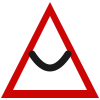
Dip
A dip in the road surface, the opposite of a hump. The risk is grounding the underside of the vehicle.
-
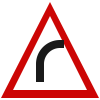
Dangerous bend to the right
A single bend, tight or with poor visibility. Speed must be shed before entering it.
-
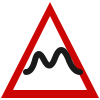
Uneven road
An irregular surface from subsidence or patching. It cuts grip and stability.
-
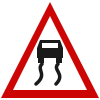
Slippery road
A surface that can turn slippery with rain, ice or spilled material.
-
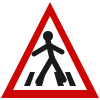
Pedestrian crossing ahead
Warns of a crossing ahead. It is a warning sign, distinct from the blue square information sign at the crossing itself.
-
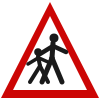
Children
Children are regularly present, for example near schools or playgrounds.
-
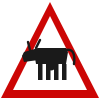
Domestic animals
Farm animals may be on the carriageway, often being driven to pasture.
-
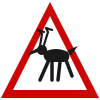
Wild animals
Wild animals may cross. It is a different sign from the domestic animals one.
-
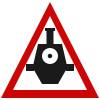
Level crossing without barriers
A railway crossing with no barriers. Approach slowly enough to be able to stop.
-
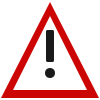
Other dangers
A hazard no other sign covers. It must carry a panel stating what the hazard is.
-
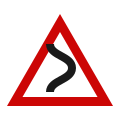
Double bend, first to the right
Two consecutive bends in opposite directions, the first to the right. Overtaking is forbidden along the whole stretch.
-
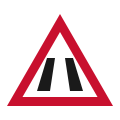
Road narrows on both sides
The carriageway narrows on both sides. Slow down and judge the width of anything coming the other way.
-
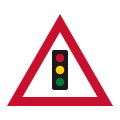
Traffic signals
Warns of traffic signals ahead, often where they cannot be seen from a distance. It precedes the signal, it does not replace it.
Prohibitory signs
A red bordered circle on white. They forbid something from the point where they stand, unless a panel says otherwise.
-
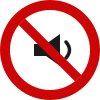
No sounding of horn
Forbids use of the horn. It stays permitted where there is immediate danger to safety.
-
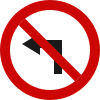
No left turn
Forbids turning left at the next junction. It also forbids a U turn.
-
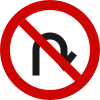
No U turn
Forbids reversing direction from where it stands until the next junction.
-
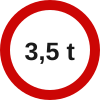
No vehicles over the mass shown
Forbids vehicles whose laden mass exceeds the figure shown in tonnes.
-
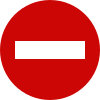
No entry
No vehicle may enter in that direction. The other end of the street carries the one way sign.
-

No vehicles
No vehicles may pass in either direction, other than the exceptions the panels state.
-
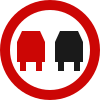
No overtaking
No overtaking of motor vehicles other than two wheeled motorcycles, until the end of restriction sign.
-
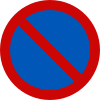
No parking
No parking, meaning a prolonged stop with the driver free to leave. A brief halt is still allowed.
-
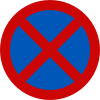
No stopping
Even a brief halt is forbidden, so it is stricter than the no parking sign.
-
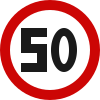
Maximum speed limit
The stated speed may not be exceeded, from that point until an end sign or a different limit.
-
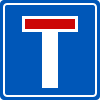
No through road
The road has no way out. It forbids nothing: it warns that the driver will have to come back.
Priority signs
Not prohibitions: they set who goes first. The inverted triangle and the stop sign are the two most often confused.
-
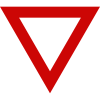
Give way
A triangle point downwards. Give way, and stop only if stopping is needed to do so.
-
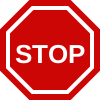
Stop
The driver must stop before the line in every case, even with the road clear, then give way.
-
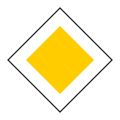
Priority road
A yellow diamond with a white border. The road being travelled has priority at the junctions ahead.
-
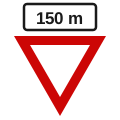
Give way ahead
Warns that a give way sign lies ahead. It exists where the sign itself cannot be seen in time.
-
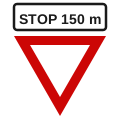
Stop ahead
Warns of a stop sign ahead. The driver must prepare to stop, not stop here.
-
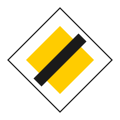
End of priority road
The barred yellow diamond ends the stretch where the road had priority. Beyond it the ordinary rules apply.
Supplementary panels
A white rectangle with a black border, fixed under another sign. It never stands alone: it states the distance, the length, the hours or the vehicles excluded from the sign above it.
-
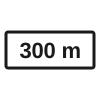
Distance panel
States how many metres ahead the sign or hazard above it applies. It prescribes nothing on its own.
-
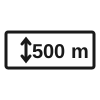
Extent panel
States for how many metres the restriction or hazard above it continues.
-
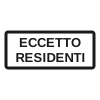
Except residents panel
Exempts residents of the area from the prohibition above. Everyone else remains subject to it.
-
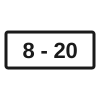
Time panel
Limits the sign above it to the hours shown. Outside those hours the restriction does not apply.
-
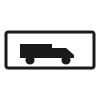
Lorry silhouette panel
Applies the sign above it to the depicted category only, here lorries.
Mandatory signs
A blue circle with a white symbol. They require something rather than forbidding it, a direction to follow for instance.
-

Turn right ahead
Requires the driver to go right. Continuing straight ahead is not an option.
-

Pass on the left
Requires passing to the left of an obstacle or a traffic island. It is not a turn.
-
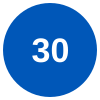
Minimum speed
Requires the driver not to go below the speed shown. Vehicles unable to reach it must not use that road or lane.
-
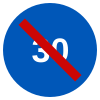
End of minimum speed
Marks the end of the minimum speed requirement set by the matching sign.
-
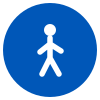
Pedestrian route
Reserves the route for pedestrians and requires them to use it. Vehicles may not enter.
-

Ahead only
The driver must continue straight ahead. It is an obligation, not a ban on turning: shape and colour tell them apart.
-

Roundabout
The roundabout must be taken in the direction the arrows show. Inside it, traffic already circulating has priority where signed.
Why the shape matters more than the drawing
Most sign mistakes in the exam come from two confusions: the downward pointing triangle read as a prohibition, and the stop sign treated as a prohibition rather than a priority sign. The shape already says which family a sign belongs to, and the family says what kind of obligation it carries.
The drawings here reproduce the shape, proportion and colour the regulation prescribes, not ministerial files. They exist to make a sign recognisable: for the text of the rule, the Highway Code governs.
Frequently asked questions about the signs
How many road signs are needed for the theory test?
There is no fixed number to memorise. The exam tests what a sign means through true or false statements, and the families that recur most are warning, prohibitory, mandatory and priority signs.
What is the difference between give way and stop?
Give way requires letting others pass, and stopping only if stopping is needed to do it. Stop requires halting before the line in every case, even with the road clear, and only then giving way.
Are the signs on this site the official ones?
The drawings are original, made from the shapes, proportions and colours the implementing regulation prescribes. They are not reproduced ministerial files, and they exist to make a sign recognisable rather than to replace the text of the rule.
Does the other dangers sign always need a panel?
Yes. The generic hazard sign does not say what the hazard is, so it must carry a panel stating it. On other warning signs the panel is optional and gives distance or extent.
Data as of . Source: Ministero delle Infrastrutture e dei Trasporti (MIT).