Lesson and quiz, category B licence

Prohibitory signs (Segnali di divieto)

On the exam this topic tests how prohibitory signs look, where they stop applying, and what the no vehicles, no entry, no overtaking, no parking and no stopping signs really forbid; this site has 22 true or false statements to practise on it.

The theory exam has 30 statements in 20 minutes and you pass with at most 3 mistakes. Source: Codice della Strada.

Skip to the quiz Study the rules

The real theory exam is in Italian, with French or German available on request. Lessons here keep the Italian terms in italics, and the quiz shows each statement in Italian with English help underneath. Switch to Italian only in the quiz to practise under exam conditions.

The rules

Question 1 of 1

Rule 1

Shape, and where a restriction ends

Prohibitory signs are normally round with a red border, and the symbol shows what is banned. The ban applies from the sign onwards. Prohibitory signs must be repeated after every junction (intersezione): if not repeated, the ban ends at the junction (Reg. art. 104 c. 2). With no time panel it applies at all hours, apart from urban no parking signs.

Example

You pass a no overtaking sign with no panels and soon cross a junction. From there the ban no longer applies unless it is signed again.

Legal reference: Reg. art. 104, c. 5; Reg. art. 116

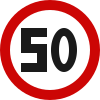
Maximum speed limit
Maximum speed limit (Limite massimo di velocità)

Exam traps

  • «Prohibitory signs apply soltanto (only) in daylight»: false, a time band exists only when a panel shows one.
  • «The ban ends where the carriageway has two lanes each way»: the number of lanes never ends a restriction.
  • Di regola (as a rule) makes the statement about the round shape true, since there are exceptions.

Rule 2

No vehicles, no entry, no motor vehicles

The no vehicles sign (divieto di transito), a white disc with a red border and no symbol, closes the road to vehicles in both directions; it does not apply to pedestrians. The no entry sign (senso vietato), a red disc with a white bar, stops you entering and stands at the exit end of a one way street. The no motor vehicles sign (transito vietato a tutti gli autoveicoli) also covers three wheeled motor vehicles and motor quadricycles, not bicycles (Reg. art. 117).

Example

At the mouth of a street you see the red disc with a white bar. The street is one way towards you, so you take another route.

Legal reference: Reg. art. 116

No vehicles
No vehicles (Divieto di transito)

Exam traps

  • «It anche (also) bans pedestrians»: false, the no vehicles sign is aimed at vehicles.
  • «It concerns lorries soli (only)»: false, lorries have their own sign with a lorry symbol.
  • The no entry sign does not confirm you are going the right way; it tells you not to enter from that end.

Rule 3

No overtaking

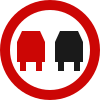
The no overtaking sign bans overtaking motor vehicles (veicoli a motore). Mopeds, two wheeled motorcycles and bicycles may still be passed, as long as it is safe. The sign does not replace the general rules: where art. 148 already bans overtaking, the ban holds with or without a sign.

Example

Under a no overtaking sign you catch up with a slow moped on a wide road with a clear view. You may pass it, but not a slow car.

Legal reference: Reg. art. 116; CdS art. 148

No overtaking
No overtaking (Divieto di sorpasso)

Exam traps

  • «It does not prevent passing a velocipede (pedal cycle)»: true, the ban covers motor vehicles.

Rule 4

No parking and no stopping

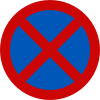
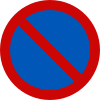
The no parking sign (divieto di sosta), one bar, bans leaving the vehicle but still allows a brief stop to let people in or out (fermata). The no stopping sign (divieto di fermata), two crossed bars, bans that brief stop too, and any voluntary halt. In built up areas a no parking sign without a time panel applies from 8 to 20; outside built up areas it applies at all hours.

Example

Under a no parking sign you pull in to drop a friend and leave straight away: that is a stop, and it is allowed. Under a no stopping sign it is not.

Legal reference: Reg. art. 120; CdS art. 157, c. 1

No stopping
No stopping (Divieto di fermata)

Exam traps

  • «The no parking sign anche (also) bans stopping»: false.
  • «To answer the phone» under a no stopping sign: false, every voluntary halt is banned.
  • «It also bans transito (driving through)»: false, you may drive along the stretch.

Rule 5

«Except» panels and other bans

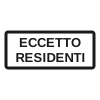
A panel starting with eccetto (except) removes the listed categories from the ban, which still applies to everyone else. The no horn sign does not stop you sounding the horn to avoid immediate danger. The no left turn sign also rules out a U-turn. A figure in tonnes on a prohibitory sign refers to the fully laden mass.

Example

Below a no vehicles sign is the panel «eccetto residenti» (except residents). People who live in the street may drive in; someone just looking for parking may not.

Legal reference: Reg. art. 116; Reg. art. 83

Except residents panel
Except residents panel (Pannello eccetto residenti)

Exam traps

  • «It still allows a U-turn»: false, a U-turn starts with a move to the left.
  • The tonnes refer to the vehicle's actual mass as it passes, not the gross laden mass on the registration document.

Rule 6

What can go wrong

Three situations show why reading a prohibitory sign means reading its panels and its context. First: in central Rome a no parking sign has no time panel at first glance. At nine in the evening the driver leaves the car, remembering that in built up areas the ban runs from 8 to 20. Below the sign, though, a small 0-24 panel extends validity to the whole day. In the morning the car is at the pound. The mistake is reading the sign without the panel: art. 116 of the Regolamento treats panels as part of the sign. Second: a street with a no vehicles sign and a panel eccetto residenti (except residents) in Naples. The driver enters, thinking they may drive through to reach a restaurant, because the street is wide and has no gate. The ZTL cameras record it. A fine and points on the licence, because the exception applies only to the listed category, and someone outside it is not a resident. Third: a hospital in Turin with no stopping signs on both sides. A driver pulls in to answer a call and stays behind the wheel for two minutes. An officer passes and fines them anyway. The no stopping ban covers every voluntary halt, and sitting at the wheel does not turn a stop into a mere traffic halt. Three practical points follow. Panels are always read with the sign, and a time panel or a 0-24 panel changes the hours of the ban. An exception eccetto residenti, eccetto autorizzati or eccetto veicoli in servizio is closed, and does not extend by analogy. The no stopping sign, with its two crossed bars, does not allow even a few minutes' halt for a phone call.

Legal reference: Reg. art. 116; CdS art. 158

CdS: Codice della Strada (d.lgs. 285/1992). Reg.: its implementing regulation (d.P.R. 495/1992). c.: comma, the numbered paragraph of an article.

Full text of the Codice: www.aci.it/i-servizi/normative/codice-della-strada.html

Trap words

False statements on the exam often repeat a true rule and change a single word. These are the Italian words to read carefully in this topic. They stay in Italian because that is how they appear on the exam.

Words for this topic

velocipede
pedal cycle. A vehicle moved by pedals, such as a bicycle; it is not a motor vehicle.
The no overtaking sign covers motor vehicles, so a velocipede (bicycle) may be passed if it is safe.
prima intersezione
first junction. Where a restriction with no panel and no end sign stops applying.
A no parking sign without panels applies from the sign up to the prima intersezione (first junction).
eccetto
except. On a panel it names who is exempt; the ban still applies to everyone else.
No vehicles, «eccetto residenti» (except residents): only people who live there may drive in.
veicoli a motore
motor vehicles. Every vehicle driven by an engine: cars, motorcycles, lorries. Not bicycles.
«The no motor vehicles sign concerns lorries only»: false.
transito
passing through. A no parking sign does not ban driving through; a no vehicles sign does.
«The no parking sign also bans transito (driving through)»: false.

Words that appear in every topic

sempre
always. An absolute: the statement is true only if there is no exception at all.
«Keeping to the limit sempre (always) guarantees a safe speed»: false, in fog or on ice you go slower.
solo, soltanto, esclusivamente
only. It rules out every other case, so a single exception makes the statement false.
«The children sign is placed soltanto (only) outside primary schools»: false, it also appears near parks and sports grounds.
mai, in nessun caso
never, in no case. The statement is true only if the behaviour is not allowed in any situation.
«A driver with priority may in nessun caso (never) give it up»: false, they may, as long as they make it clear.
ovvero
In the language of the Codice it means «or» and introduces an alternative. It does not mean «that is».
Emergency stop: the vehicle has broken down ovvero (or) the driver must stop because they feel unwell (art. 157). Two separate cases; either one is enough.
obbligatoriamente, è obbligatorio
compulsory. A duty: it is not enough for the behaviour to be allowed, it must be required.
«Overtaking on the left is obbligatorio (compulsory) even past a driver turning left»: false, in that case you pass on the right.
è consentito, è ammesso
allowed, permitted. A permission, not a duty. «È consentito» does not mean «è obbligatorio», and the reverse.
«It is consentito (allowed) to pass on the right a driver who has signalled a left turn»: true, and art. 148(7) actually requires it.
di norma, di regola
as a rule, normally. It states the general rule, which allows exceptions, so the statement does not claim to hold in every case.
«Outside built up areas warning signs are placed di norma (as a rule) 150 metres ahead»: true, and a panel gives any other distance.
anche
also, even. It stretches the rule to one more case; ask whether that added case really belongs.
«The no parking sign anche (also) bans stopping»: false, a brief stop is still allowed under a no parking sign.
automaticamente, di per sé
automatically, in itself. It suggests an effect that applies on its own, when the effect usually depends on a sign or a specific condition.
«In fog the motorway limit automaticamente (automatically) drops to 90 km/h»: false, the automatic cut applies to rain and snow.
qualsiasi, qualunque, in ogni caso
any, in every case. It generalises; look for the category or situation the rule leaves out.
«The safe distance is the same at qualunque (any) speed»: false, it grows with speed.
corsia
lane. The part of the carriageway wide enough for one line of vehicles (art. 3).
A two way carriageway (carreggiata) usually has two corsie (lanes), one for each direction.
carreggiata
carriageway. The part of the road for vehicles, made up of one or more lanes (art. 3). It does not include the verge or the pavement.
A speed limit applies to the whole carreggiata (carriageway), not only to the lane next to the sign.
banchina
verge, hard strip. The strip beside the carriageway and outside it, not meant for driving (art. 3).
Outside built up areas you park off the carriageway, for example on a suitable banchina (verge) (art. 157(3)).
fermata
stop. A brief halt to let people get in or out, with the driver present and ready to move off (art. 157).
Pulling in to drop off a passenger and leaving straight away is a fermata (stop), not a sosta (parking).
sosta
parking. A prolonged halt during which the driver may leave the vehicle (art. 157).
A divieto di sosta (no parking) does not ban stopping; a divieto di fermata (no stopping) bans parking too.
arresto
halt. An interruption caused by traffic, such as a red light or a queue. It is not the driver's choice (art. 157).
Stopping at a red light is an arresto (halt); no stopping ban prevents it.
Check yourself

Three statements on the topic. Answer and see straight away whether the rule has stuck. These answers are not saved.

Question 1 of 1

  1. Il segnale divieto di sosta vieta anche la fermata per la salita e la discesa dei passeggeri.

    The no parking sign also bans a brief stop to let passengers get in or out.

    Circular blue sign with a red border and one red diagonal bar
  2. Il segnale divieto di sorpasso non impedisce di superare un velocipede.

    The no overtaking sign does not prevent passing a pedal cycle.

    Circular red-bordered sign with two cars side by side, the left one red
  3. Il segnale divieto di svolta a sinistra consente comunque l'inversione di marcia.

    The no left turn sign still allows a U-turn.

Topic quiz: 22 statements

Untimed. After each answer you see the solution, the explanation, the trap words highlighted and a link back to the rule. At the end you get your score and can retest just the ones you missed.

Question 1 of 1

  1. I segnali di divieto hanno di regola forma circolare con bordo rosso.

    Prohibitory signs are normally round with a red border.

  2. Il segnale divieto di transito vieta la circolazione nei due sensi di marcia.

    The no vehicles sign bans traffic in both directions.

    Circular sign, white ground with a wide red border
  3. Il segnale senso vietato indica che si sta percorrendo una strada a senso unico nel verso corretto.

    The no entry sign means the one way street is being driven in the correct direction.

    Circular red sign with a white horizontal bar
  4. Se dopo un'intersezione il segnale di divieto di sorpasso non viene ripetuto, il divieto non vale più oltre quell'intersezione.

    If the no overtaking sign is not repeated after a junction, the ban no longer applies beyond that junction.

    Circular red-bordered sign with two cars side by side, the left one red
  5. Il segnale divieto di sosta vieta anche la fermata per la salita e la discesa dei passeggeri.

    The no parking sign also bans a brief stop to let passengers get in or out.

    Circular blue sign with a red border and one red diagonal bar
  6. Il segnale divieto di fermata consente di arrestarsi per fare scendere un passeggero.

    The no stopping sign allows halting to let a passenger get out.

    Circular blue sign with a red border and two crossed red bars
  7. Il segnale transito vietato a tutti gli autoveicoli vieta il transito anche alle biciclette.

    The no motor vehicles sign (transito vietato a tutti gli autoveicoli) also bans bicycles.

  8. Il segnale di divieto con l'indicazione di una massa in tonnellate riguarda la massa a pieno carico del veicolo.

    A prohibitory sign showing a mass in tonnes refers to the vehicle mass when fully laden.

  9. Il segnale divieto di sorpasso non impedisce di superare un velocipede.

    The no overtaking sign does not prevent passing a pedal cycle.

    Circular red-bordered sign with two cars side by side, the left one red
  10. In mancanza di pannelli il divieto di sosta vale dal segnale fino alla prima intersezione.

    Where no panels are fitted, a no parking restriction runs from the sign to the first junction.

    Circular blue sign with a red border and one red diagonal bar
  11. Il segnale senso vietato si trova all'estremità di una strada a senso unico opposta a quella dove è posto il segnale di senso unico.

    The no entry sign stands at the end of a one way street opposite the end carrying the one way sign.

    Circular red sign with a white horizontal bar
  12. Il segnale divieto di segnalazioni acustiche non impedisce di usare il clacson in caso di pericolo immediato.

    The no horn sign does not prevent sounding the horn in the face of immediate danger.

  13. Il segnale di limite massimo di velocità continua a valere dopo un'intersezione anche se non viene ripetuto.

    A maximum speed limit sign keeps applying after a junction even if it is not repeated.

    Circular red-bordered sign showing the number 50
  14. Un divieto di sosta con pannello dalle 8 alle 20 lascia libera la sosta durante la notte.

    A no parking sign with a panel reading 8 to 20 leaves parking free overnight.

  15. Il pannello eccetto autorizzati sotto un divieto di transito limita il divieto ai soli veicoli non autorizzati.

    An except authorised vehicles panel under a no traffic sign limits the ban to vehicles without authorisation.

  16. Il divieto di sorpasso cessa di valere quando la carreggiata ha due corsie per senso di marcia.

    A no overtaking restriction stops applying where the carriageway has two lanes in each direction.

    Red bordered circle with two cars side by side, the left one in red
  17. Il segnale divieto di transito vieta il passaggio anche ai pedoni.

    The no traffic sign also bans pedestrians.

    Circular sign, white ground with a wide red border
  18. Il segnale divieto di sosta vieta anche il transito nel tratto interessato.

    The no parking sign also bans driving through the stretch concerned.

    Blue circle with a red border and one red oblique bar
  19. Nel tratto con divieto di fermata è consentito arrestarsi per rispondere al telefono.

    In a no stopping zone it is allowed to pull up to answer the phone.

    Circular blue sign with a red border and two crossed red bars
  20. Il segnale divieto di svolta a sinistra consente comunque l'inversione di marcia.

    The no left turn sign still allows a U-turn.

  21. Il segnale transito vietato a tutti gli autoveicoli riguarda i soli autocarri.

    The no motor vehicles sign (transito vietato a tutti gli autoveicoli) concerns lorries only.

  22. I segnali di divieto sono validi soltanto nelle ore diurne.

    Prohibitory signs apply only during daylight hours.

What next

All exam topics

Educational content. For the official rules, see the Codice della Strada and legal notes.