Lesson and quiz, category B licence

Speed limits (Limiti di velocità)

On the exam this topic tests the default limits for each road type, the cuts in rain and snow, the limits for newly licensed drivers, the duty to adapt your speed, and the penalties for speeding; this site has 22 true or false statements to practise on it.

The theory exam has 30 statements in 20 minutes and you pass with at most 3 mistakes. Source: Codice della Strada.

Skip to the quiz Study the rules

The real theory exam is in Italian, with French or German available on request. Lessons here keep the Italian terms in italics, and the quiz shows each statement in Italian with English help underneath. Switch to Italian only in the quiz to practise under exam conditions.

The rules

Question 1 of 1

Rule 1

Default speed limits

Without other signs the maximum speed is 130 km/h on motorways (autostrade), 110 km/h on main rural roads (extraurbane principali), 90 km/h on secondary and local rural roads (extraurbane secondarie e locali) and 50 km/h in built up areas (centri abitati), at any hour. A council may raise the urban limit to 70 km/h on suitable roads, with signs; a sign can also set a limit lower than the default, and it applies to the whole carriageway.

Example

You leave a village on a single carriageway two way road with no limit signs. It is a secondary rural road, so the maximum is 90 km/h.

Legal reference: CdS art. 142, c. 1

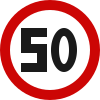
Maximum speed limit
Maximum speed limit (Limite massimo di velocità)

Exam traps

  • 110 and 90 are easy to swap: 110 km/h is the main rural road, 90 km/h the secondary one.
  • «The 50 km/h limit applies soltanto (only) in daylight»: false.
  • «It applies solo to the lane next to the sign»: false, it applies to the carriageway, unless overhead signs give lane by lane limits.

Rule 2

Rain, snow and fog

With precipitation of any kind (precipitazioni atmosferiche) the limits fall to 110 km/h on motorways and 90 km/h on main rural roads. For fog art. 142 sets no automatic figure: the duty to match speed to visibility applies, and that often means going much slower.

Example

It starts to rain on the motorway. The limit becomes 110 km/h, even if the lane is empty and no electronic signs say so.

Legal reference: CdS art. 142, c. 1; CdS art. 141

Exam traps

  • «In fog the limit automaticamente (automatically) drops to 90 km/h»: false, the automatic cut is for precipitation.
  • The cut depends on precipitation, and the figures differ by road: 110 on motorways, 90 on main rural roads.

Rule 3

A suitable speed

The limit is a ceiling, not a target. You set your speed on the state of the vehicle, the road and the traffic, so that you can stop within the distance you can see, and you slow down where visibility is poor, on bends, near schools, at night and in bad weather. Driving so slowly that you obstruct traffic is also banned.

Example

You pass a school as the pupils come out, with a 50 limit. Even with no signs you go much slower, ready to stop.

Legal reference: CdS art. 141

Exam traps

  • «Keeping to the limit sempre (always) guarantees a safe speed»: false.
  • «A value to be reached»: false, the limit is a ceiling.
  • Slow is not always safe: on a motorway an unjustified low speed is an obstruction.

Rule 4

New drivers and vehicles with their own limits

For the first three years after passing the category B test you may not exceed 100 km/h on motorways or 90 km/h on main rural roads. For licences issued from 14 December 2024 the same period brings power limits of 75 kW/t and, for cars, 105 kW. Some vehicles have their own lower limits, such as heavy vehicles and vehicles towing trailers.

Example

You passed your test two years ago and join the motorway. Your personal limit is 100 km/h, even where signs show 130.

Legal reference: CdS art. 117 (Legge 177/2024); CdS art. 142, c. 3

Exam traps

  • «After the first year»: false, the lower limits last the full three years.
  • Neopatentato (new driver): 100 on motorways, 90 on main rural roads. On secondary roads the limit stays 90 as for everyone.

Rule 5

Penalties and exemptions

Penalties rise in bands of excess speed: up to 10 km/h, 10 to 40, 40 to 60, over 60. Over 40 km/h the licence is also suspended for 1 to 3 months; over 60 km/h for 6 to 12 months. Police, fire and ambulance vehicles may exceed limits only on urgent duty with siren and lights on together.

Example

You are caught at 115 km/h in a 50 zone. That is 65 km/h over, so the top fine band and a 6 to 12 month suspension.

Legal reference: CdS art. 142, c. 7, 8, 9, 9-bis; CdS art. 177

Exam traps

  • «Anche (even) without siren and lights»: false.
  • «Over 60» and «40 to 60» are different bands with different suspensions: check the figure.

Rule 6

What can go wrong

Three scenarios show that the limit on the sign is not enough to keep the car safe. First: a new driver runs on the A22 at 128 km/h with the sign at 130. Their personal limit, set by art. 117 and art. 142, c. 3, stays at 100 km/h for the first three years. A speed camera picks it up and the fine falls in the band for 10 to 40 km/h over 100. No excuse works; the sign limit is for other drivers. Second: in the rain on the A4 the driver stays at 130 km/h because the carriageway looks clear. With precipitation the limit drops to 110 km/h even without any electronic overhead signs, as art. 142, c. 2 says. A puddle triggers aquaplaning, the car loses grip and ends against the barrier. The wet weather cut was the safety margin, and ignoring it pushed the speed past the point of control. Third: outside a school in Milan at home time the limit is 50 km/h. The driver goes 45. A child steps out from behind a parked van and crosses. Art. 141 requires speed to match the local conditions and the likely presence of pedestrians, so a safe speed in that stretch was 20 or 25 km/h. The fine is the light part; hitting the child is the real cost. The shared point is that the limit is a ceiling, not a target. New drivers, rain, fog, tight bends, schools and roadworks are all conditions in which a safe speed sits below the one allowed. The bands in art. 142, c. 7-9 punish excess, but civil and criminal liability come from unsuitable speed, not only from beating the sign.

Legal reference: CdS art. 117; CdS art. 141; CdS art. 142

CdS: Codice della Strada (d.lgs. 285/1992). Reg.: its implementing regulation (d.P.R. 495/1992). c.: comma, the numbered paragraph of an article.

Full text of the Codice: www.aci.it/i-servizi/normative/codice-della-strada.html

Trap words

False statements on the exam often repeat a true rule and change a single word. These are the Italian words to read carefully in this topic. They stay in Italian because that is how they appear on the exam.

Words for this topic

dispositivi acustici e luminosi
siren and blue flashing lights. Emergency vehicles are exempt from traffic rules only with both switched on together.
An ambulance with neither siren nor lights on is treated like any other vehicle.
centro abitato
built up area. The zone between the town entry and exit signs; many rules differ inside and outside it.
Outside a centro abitato you park off the carriageway; inside it you pull in to the right hand edge.
extraurbana principale, secondaria
main and secondary rural road. Two road types with different limits: 110 km/h on a main road, 90 km/h on a secondary one.
«On extraurbane secondarie (secondary rural roads) the limit is 110 km/h»: false, it is 90 km/h.
neopatentato
newly licensed driver. Someone who has held a category B licence for less than three years, with lower speed and power limits.
The lower limits apply for the full three years, not only the first.
precipitazioni atmosferiche
rain, snow or hail falling. They lower the limits on motorways and main rural roads; fog is not a precipitation.
With precipitazioni (rain or snow): 110 km/h on motorways, 90 km/h on main rural roads.

Words that appear in every topic

sempre
always. An absolute: the statement is true only if there is no exception at all.
«Keeping to the limit sempre (always) guarantees a safe speed»: false, in fog or on ice you go slower.
solo, soltanto, esclusivamente
only. It rules out every other case, so a single exception makes the statement false.
«The children sign is placed soltanto (only) outside primary schools»: false, it also appears near parks and sports grounds.
mai, in nessun caso
never, in no case. The statement is true only if the behaviour is not allowed in any situation.
«A driver with priority may in nessun caso (never) give it up»: false, they may, as long as they make it clear.
ovvero
In the language of the Codice it means «or» and introduces an alternative. It does not mean «that is».
Emergency stop: the vehicle has broken down ovvero (or) the driver must stop because they feel unwell (art. 157). Two separate cases; either one is enough.
obbligatoriamente, è obbligatorio
compulsory. A duty: it is not enough for the behaviour to be allowed, it must be required.
«Overtaking on the left is obbligatorio (compulsory) even past a driver turning left»: false, in that case you pass on the right.
è consentito, è ammesso
allowed, permitted. A permission, not a duty. «È consentito» does not mean «è obbligatorio», and the reverse.
«It is consentito (allowed) to pass on the right a driver who has signalled a left turn»: true, and art. 148(7) actually requires it.
di norma, di regola
as a rule, normally. It states the general rule, which allows exceptions, so the statement does not claim to hold in every case.
«Outside built up areas warning signs are placed di norma (as a rule) 150 metres ahead»: true, and a panel gives any other distance.
anche
also, even. It stretches the rule to one more case; ask whether that added case really belongs.
«The no parking sign anche (also) bans stopping»: false, a brief stop is still allowed under a no parking sign.
automaticamente, di per sé
automatically, in itself. It suggests an effect that applies on its own, when the effect usually depends on a sign or a specific condition.
«In fog the motorway limit automaticamente (automatically) drops to 90 km/h»: false, the automatic cut applies to rain and snow.
qualsiasi, qualunque, in ogni caso
any, in every case. It generalises; look for the category or situation the rule leaves out.
«The safe distance is the same at qualunque (any) speed»: false, it grows with speed.
corsia
lane. The part of the carriageway wide enough for one line of vehicles (art. 3).
A two way carriageway (carreggiata) usually has two corsie (lanes), one for each direction.
carreggiata
carriageway. The part of the road for vehicles, made up of one or more lanes (art. 3). It does not include the verge or the pavement.
A speed limit applies to the whole carreggiata (carriageway), not only to the lane next to the sign.
banchina
verge, hard strip. The strip beside the carriageway and outside it, not meant for driving (art. 3).
Outside built up areas you park off the carriageway, for example on a suitable banchina (verge) (art. 157(3)).
fermata
stop. A brief halt to let people get in or out, with the driver present and ready to move off (art. 157).
Pulling in to drop off a passenger and leaving straight away is a fermata (stop), not a sosta (parking).
sosta
parking. A prolonged halt during which the driver may leave the vehicle (art. 157).
A divieto di sosta (no parking) does not ban stopping; a divieto di fermata (no stopping) bans parking too.
arresto
halt. An interruption caused by traffic, such as a red light or a queue. It is not the driver's choice (art. 157).
Stopping at a red light is an arresto (halt); no stopping ban prevents it.
Check yourself

Three statements on the topic. Answer and see straight away whether the rule has stuck. These answers are not saved.

Question 1 of 1

  1. Sulle strade extraurbane secondarie il limite generale è di 110 km/h.

    On secondary extra urban roads the general limit is 110 km/h.

  2. Il conducente neopatentato può raggiungere i 130 km/h in autostrada come tutti gli altri conducenti.

    A newly licensed driver may reach 130 km/h on the motorway like everyone else.

  3. Il conducente deve regolare la velocità in modo da poter arrestare il veicolo entro i limiti del suo campo di visibilità.

    A driver must set their speed so the vehicle can stop within the range of visibility.

Topic quiz: 22 statements

Untimed. After each answer you see the solution, the explanation, the trap words highlighted and a link back to the rule. At the end you get your score and can retest just the ones you missed.

Question 1 of 1

  1. Nei centri abitati il limite generale di velocità è di 50 km/h.

    Inside built up areas the general speed limit is 50 km/h.

  2. Sulle autostrade il limite generale per le autovetture è di 130 km/h.

    On motorways the general limit for cars is 130 km/h.

  3. Sulle strade extraurbane secondarie il limite generale è di 110 km/h.

    On secondary extra urban roads the general limit is 110 km/h.

  4. In caso di pioggia il limite in autostrada scende a 110 km/h.

    In rain the motorway limit drops to 110 km/h.

  5. Il conducente neopatentato può raggiungere i 130 km/h in autostrada come tutti gli altri conducenti.

    A newly licensed driver may reach 130 km/h on the motorway like everyone else.

  6. Rispettare il limite massimo garantisce sempre di viaggiare a una velocità sicura.

    Keeping to the maximum speed limit always guarantees a safe speed.

  7. Una velocità troppo bassa in autostrada può costituire intralcio alla circolazione.

    Driving too slowly on a motorway can obstruct traffic.

  8. In prossimità delle scuole occorre ridurre la velocità anche in assenza di segnali.

    Near schools speed must be reduced even where there are no signs.

  9. Sulle strade extraurbane principali il limite generale di velocità è di 110 km/h.

    On main extra urban roads the general speed limit is 110 km/h.

  10. Con neve o ghiaccio sulla carreggiata la velocità va ridotta anche al di sotto del limite indicato dai segnali.

    With snow or ice on the road, speed must be cut even below the posted limit.

  11. Un segnale di limite massimo di velocità può imporre un valore inferiore a quello generale della strada percorsa.

    A maximum speed sign can impose a value lower than the general limit of the road being driven.

    Red bordered circle with the number 50 in black on white
  12. Il conducente deve regolare la velocità in modo da poter arrestare il veicolo entro i limiti del suo campo di visibilità.

    A driver must set their speed so the vehicle can stop within the range of visibility.

  13. Il neopatentato non può superare i 90 km/h sulle strade extraurbane principali.

    A newly licensed driver may not exceed 90 km/h on main extra urban roads.

  14. Superare il limite di velocità di oltre 60 km/h comporta, oltre alla sanzione pecuniaria, la sospensione della patente.

    Exceeding the speed limit by more than 60 km/h brings suspension of the licence as well as a fine.

  15. Il comune può elevare il limite urbano fino a 70 km/h sulle strade con caratteristiche idonee.

    A council may raise the urban limit to 70 km/h on roads with suitable characteristics.

  16. In caso di nebbia il limite autostradale scende automaticamente a 90 km/h.

    In fog the motorway limit automatically drops to 90 km/h.

  17. Il limite indicato da un segnale vale solo per la corsia in cui il segnale è collocato.

    A posted speed limit applies only to the lane where the sign stands.

  18. I neopatentati possono raggiungere il limite generale delle autostrade dopo il primo anno di patente.

    Newly licensed drivers may use the general motorway limit after their first year.

  19. Un'autovettura che traina un rimorchio può viaggiare a 90 km/h sulle strade extraurbane.

    A car towing a trailer may travel at 90 km/h on extra urban roads.

  20. La velocità massima consentita è un valore da raggiungere per non intralciare il traffico.

    The maximum permitted speed is a value to be reached so as not to hold up traffic.

  21. I veicoli di polizia possono superare i limiti di velocità anche senza azionare i dispositivi acustici e luminosi.

    Police vehicles may exceed the speed limits even without switching on siren and beacons.

  22. Nei centri abitati il limite di 50 km/h si applica soltanto nelle ore diurne.

    Inside built up areas the 50 km/h limit applies only in daylight hours.

What next

All exam topics

Educational content. For the official rules, see the Codice della Strada and legal notes.